Journal · 16 October 2026 · 7 min read
Buying a Kanchipuram Saree Online vs In Kanchipuram: Pros, Cons and Red Flags
The question every Kanchipuram saree buyer asks
Should you board a train to the temple town, or click "buy" from your sofa? Both can get you a genuine Kanchipuram silk saree, and both can leave you with an expensive fake. The difference is not the place. It is how much you can verify before you pay.
We are Kaushah, and we sell Kanchipuram silk sarees online, so we will be upfront: online is not always the better choice. Below we lay out the honest pros and cons of each route, help you decide which suits your situation, and list the red flags that should make you walk away.
First, know what you are paying for
Wherever you shop, you are paying for four things: pure mulberry silk, real zari, a handwoven Kanchipuram weave, and GI-protected origin. Under the GI norms, a saree sold as Kanchipuram must meet set standards for weight and zari and must be produced in the region (Vikaspedia).
In practice, that means checking:
- The silk. Dense, smooth and heavy, often 2-ply in the warp and 3-ply in the weft (Vikaspedia).
- The zari. Traditional zari is silver wire over a red silk core, coated with gold.
- The korvai border and petni pallu. Contrast border and pallu joined to the body by interlocking, visible on the reverse.
- The Silk Mark tag. Proof of pure silk, though not of Kanchipuram origin by itself.
Keep these four in mind. Every pro, con and red flag below comes back to whether you can check them.
Buying in Kanchipuram: what you gain and what you risk
Kanchipuram sits about 70 km from Chennai, and its silk shops cluster around Gandhi Road and the temple streets.
What you gain
- The touch test. Weight, drape and the firmness of the korvai join tell you more in ten seconds than any photo.
- Honest colour. Step out into daylight and see the real shade of that arakku red or peacock blue.
- Direct access to weavers. Weavers' co-operatives and government-backed outlets such as Co-optex sell at fixed prices with proper bills.
- Custom bridal work. You can commission a colour or motif straight from the loom if you have a few months.
- The experience. For many families, the trip itself becomes part of the wedding story.
What you risk
- Travel costs. Tickets, a hotel night and lost workdays can add ₹10,000 or more for families outside Tamil Nadu.
- Commission traps. Auto drivers and self-styled guides steer you to shops that pay them, and you pay that cut.
- Fakes on home ground. Powerloom and imitation-zari sarees are sold in Kanchipuram too, sometimes as handloom.
- Time pressure. A single day and crowded shops push you into quick decisions.
- Hard returns. Once you are home, exchanging a saree is difficult.
Buying Kanchipuram silk sarees online: what you gain and what you risk
Online shopping has matured, but the quality of sellers still varies widely.
What you gain
- Reach. Families in Lucknow, Pune, Singapore or Toronto can buy from Kanchipuram looms without travelling.
- Time to think. Compare prices, weights and zari types across sellers over days, not minutes.
- Everything in writing. Listings, chats, invoices and Silk Mark details create a record you can rely on later.
- Video verification. A good seller will show you the saree live in daylight, reverse side and zari close-ups included.
- Returns. Reputed stores take a saree back if it does not match its description.
What you risk
- No hands-on check. Weight and texture are the easiest things to fake through a screen.
- Colour drift. Studio lights and phone displays can shift a shade enough to clash with your jewellery.
- Misleading listings. Marketplaces are full of powerloom and art-silk sarees with "Kanchipuram" in the title.
- Borrowed photos. Some sellers lift images from established brands and ship something cheaper.
- "No returns on silk." Many sellers refuse returns or offer store credit only.
Which route suits you?
There is no single right answer. Find yourself in one of these situations:
- You live in or near Tamil Nadu and have a free weekend. Visit Kanchipuram. Pick shops in advance and start with the co-operatives.
- You live far away or abroad. Buy online from a seller who offers daylight video calls, Silk Mark details and a written return policy.
- You want a one-of-a-kind bridal design. Either route works if the seller takes custom orders; allow several weeks for weaving.
- You are buying several sarees for family. Use online stores to compare and save time, then visit in person for the bride's main saree if you can.
- You are a first-time buyer. Online with a trusted seller gives you time to learn and check; in store, take someone who has bought Kanchipuram silk before.
- You are short on time before the wedding. Online, with insured express shipping, avoids a rushed trip.
Red flags: when to walk away
Online
- A bargain that is too good. Pure zari alone costs more than many "pure Kanchipuram" listings ask for the whole saree.
- Fuzzy product names. "Kanchi-style", "soft silk", "Kanjivaram look", "semi silk" or "art silk" mean imitation.
- Missing specifications. No weight in grams, no zari type, no silk details.
- No Silk Mark, no GST invoice. A real business can provide both.
- Says no to a video call. Real stock can be shown live.
- Photos found elsewhere. A reverse image search reveals copied pictures in seconds.
- Payment to a personal UPI ID only. No registered business behind it means no recourse.
In Kanchipuram
- Your driver chooses the shop. Commission will be added to your bill.
- No printed bill. Insist on an invoice naming pure silk, zari type and weight.
- A flawless machine finish. Handloom shows tiny irregularities; perfect uniformity hints at powerloom.
- White core under the zari. Real zari has a red silk core.
- Suspiciously light for a "bridal" saree. Heavy pure-zari sarees are noticeably heavier.
- "Only one left, decide now." Pressure is a tactic, not a quality marker.
Quick checks that work anywhere
- Look at the reverse. Find the korvai and petni interlocks.
- Scratch the zari gently. Red core means real; white or plastic means imitation.
- Burn one loose thread. Pure silk smells like burnt hair and leaves soft ash; synthetic melts into a hard bead.
A note for Kanchipuram bridal and wedding sarees
The stakes are highest for a Kanchipuram bridal saree, so give yourself extra margin.
- Start 3 to 6 months ahead. Leave time for comparison, a possible exchange, fall and pico, and blouse fittings.
- Get weight and zari type on the invoice. This single line protects you more than anything a salesperson says.
- See it in daylight with your jewellery. Colour shifts are most painful in wedding photos.
- Split the risk. Many families choose the bride's main Kanchipuram wedding saree with extra care, in person or via a detailed video call, and buy lighter family sarees online.
How Kaushah bridges the gap
We built Kaushah to give online buyers the same proof they would get standing in a Kanchipuram showroom.
- Sarees sourced from Kanchipuram weavers [confirm sourcing details]
- Silk Mark certification [confirm], shared before purchase
- Weight, silk and zari type stated on every listing
- Live daylight video calls on request
- GST invoice naming every detail
- [Confirm return or authenticity guarantee terms]
Book a video consultation or browse our Kanchipuram silk sarees.
Final word
Kanchipuram gives you touch and tradition. Online gives you reach, time and a paper trail. Whichever you choose, a genuine Kanchipuram silk saree comes down to the same checks: real silk, real zari, a handwoven Kanchipuram weave, and a seller who puts it all in writing.
FAQs
Is a Kanchipuram silk saree cheaper in Kanchipuram than online? Sometimes, especially at weavers' co-operatives. Travel costs and touts' commissions can wipe out the difference.
Can I trust online Kanchipuram silk sarees? Yes, if the seller shares Silk Mark details, weight, zari type, a GST invoice and a live video, and accepts returns for authenticity issues.
What does the Silk Mark tag prove? It confirms pure silk. It does not prove the saree was woven in Kanchipuram.
How do I know a Kanchipuram bridal saree has real zari? Scratch a zari thread gently at the pallu edge. Real zari shows a red silk core.
When should I buy my Kanchipuram wedding saree? Three to six months before the wedding, and earlier for a custom design.
Woven in legacy, draped in you.
Keep reading
More from the Journal


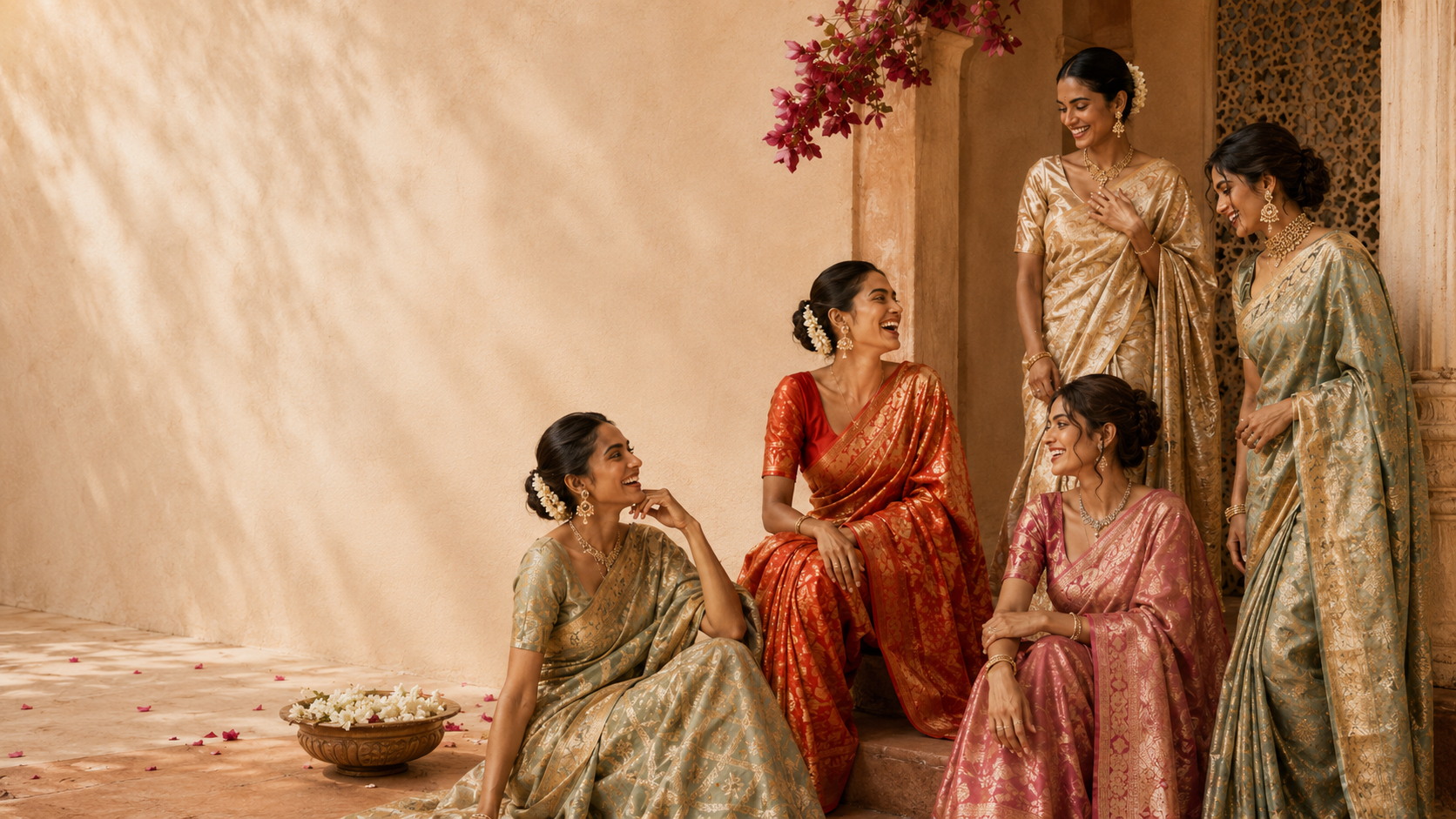
Our Story Continues
A legacy reimagined for the woman of today.
Silk and cotton, organza and georgette, heritage weaves and contemporary design, so every woman can find the drape that feels made for her.